In businesses, unpaid invoices lead to a lot of trouble. Their importance increases if we consider that small businesses can only survive with regular payments coming from their customers, as they can’t count on their own reserves or savings as large companies do. This is exactly where a collection agency for small business owners becomes a valuable partner rather than a last resort.
Often it is possible to get paid when one gets in touch with clients, but after some time it becomes ineffective to communicate with a debtor. Waiting for payment or collection of one’s debts only reduces the chances of getting paid.
In modern times, collection companies have evolved from call centers, which only make calls to their clients. Currently, the best collection agencies use the combination of the experience of debt collectors, compliance with all the laws and advanced technologies which helps them to improve recovery success.
This article explains how collection agencies work, how to know when to turn to them for help, and how to choose a company.
What Is a Collection Agency for Small Business?
A small business collection service is a specialized professional service that assists businesses in obtaining delinquent payments from clients who haven’t paid despite several requests.
Rather than having your employees look for unpaid accounts, a collection agency for small business needs will handle the account recovery.
In many cases, the agency will be responsible for ensuring communication with clients, negotiating repayments, and sometimes even receiving payments.
These agencies do not only specialize in recovering payments; they can also help businesses with the following:
- Assisting with cash flow management
- Decreasing administrative burden
- Keeping good relationships with customers
- Decreasing cost of compliance
- Increasing recovery speed through proven techniques
Regardless of whether your business is in construction, healthcare, SaaS, or wholesale, using the right collection agency for small business needs allows you to concentrate on running the business while experts collect your payments.
Why Small Businesses Need Professional Collections
Delays in payments don’t only prolong revenue receivable but also impact all operations of your business.
Whenever customers do not pay in time, companies experience the following:
- Inadequate cash flow
- Postponed payments to suppliers
- Trouble paying salaries
- High borrowing cost
- Little capacity to invest in capabilities
- Additional work for internal staff
Many business owners hesitate to turn to a collection agency for small business debt and worry that customer relationships will get ruined as a result. Nonetheless, professional debt collection agencies know how to combine professionalism with effective payment recovery.
These agencies offer an approach that is characterized by courtesy and compliance, in line with consumer protection guidance published by the Consumer Financial Protection Bureau.
When Should You Hire a Collection Agency?
One of the major errors that small businesses commit is delaying themselves from seeking professional help.
Though the various industries have distinct payment terms, firms should consider using a collection agency for small business accounts when:
- An invoice has been overdue for around 60 to 90 days
- Several reminders have been left unheeded
- The consumers keep breaking payment guarantees
- There is no communication at all
- The workers have been wasting too much time on internal collections
- Pending payment is hindering cash flow
The sooner an account is sent to the collection agency, the more likely it is to be collected successfully. The larger the time delay, the more chances debtors would have to switch contacts, to close the business, or to become bankrupt.
How Does a Collection Agency Work?
By learning about the collection procedures, business owners can understand what to expect after they submit their account to a collection agency for small business recovery.
Step 1: Account Evaluation
The agency starts the process by reviewing your paperwork, such as invoices, contracts, payment history, customer data, and previously attempted collections. It assures that your account is legitimate and helps to find the most effective way to recover the debt.
Step 2: First Contact
The collectors reach out to the client using permitted ways of communication, either by phone, email, collection letter, or text.
It’s done not for confrontation, but for establishing communication and learning the reason for the client not paying.
Step 3: Investigation and Finding Customers
If the contact information is out of date, collection companies use legal techniques to acquire fresh addresses and phone numbers.
This way, any business can reach clients who have difficult access to.
Step 4: Negotiating Payment
Not all clients are able to pay their debts completely.
A good collection company offers installment payments, settlement agreements, and short-term payment solutions.
These flexible methods increase the chances that some of the money will be recovered.
Step 5: Payment Processing
After payment has been made, funds shall be dealt with as per your arrangement with the agency, and a report on the account will be provided.
Throughout the process, agencies must keep good records and abide by all collection regulations.
How to Choose the Right Collection Agency for Your Small Business
Not every collections agency is equally experienced or competent. Picking the right collection agency for small business needs is about getting beyond mere recovery rates.
Industry Experience
The agency that knows your industry best is likely to do a better job of collections because it knows the usual billing practices, payment cycles, and behaviors of clients.
For instance, collecting debts from medical patients entails different actions than that of collecting from a commercial firm or SaaS payments.
Compliance and Regulatory Knowledge
The regulations applicable to debt collection are both at the federal and state levels. Even if collections are done by a third-party agency, your company needs to ensure that its reputation is intact.
Choose an agency that has strong compliance practices, employee training programs, call monitoring, and quality assurance processes in place.
Compliance should never be an afterthought.
Professional Communication
The treatment of customers has an impact on the business.
Look for agencies that place importance on:
- Respectful communication
- Professional language
- Ethical negotiation
- Customer education
- Flexible payment methods
- Steer clear of agencies that use aggressive or outdated tactics.
Transparent Pricing
There are various pricing methods used by collection agencies. The least expensive is not necessarily the most cost-effective option.
Before you sign an agreement, it is essential to know the following:
- Contingency fees
- The cost of fixed fees
- Minimum account setups
- Other administrative costs
- Legal collection expenses, if necessary
To get complete information about pricing structures, read how much does a collection agency cost for small businesses?
Technology and Reporting
A modern collection agency for small business clients must bring forth technology to make the process easier. Look for features such as:
- Secured client web portals
- Updates now of the operation being carried out
- Digital payment methods
- Dashboard reporting through the internet
- Automatic informational updates sent to the user’s devices
- Integration with CRM or accounting software
All these functions simplify the ability to monitor the process and performance of the agency.
Recovery Strategy
- Ask the agency about their attitude towards collections.
- Do they start with negotiations or go for escalation right away?
- How do they communicate with the customers depending on their behavior?
- Finding out about their strategy allows you to understand better how they act on your behalf.
Customer Service
The proper debt collection service treats you as their financial partner instead of just another customer.
Consider:
- Response time
- Reporting frequency
- Account service
- Contact options
- Response tone to inquiries
Good communication between your organization and the agency leads to better recovery.
Collection Agency Pricing Models
Most agencies make a profit by using one of the three payment models.
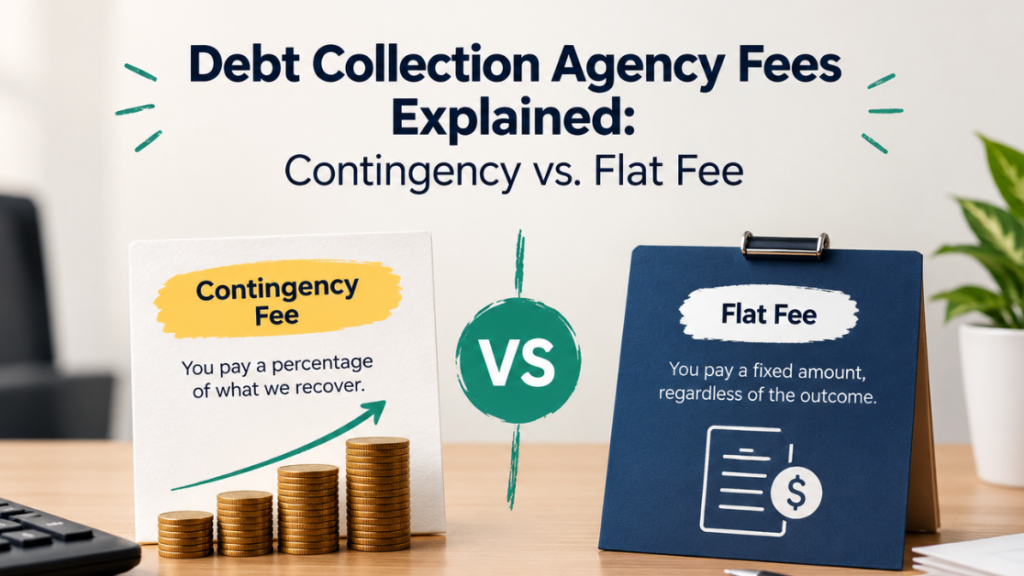
Fees Based on a Percentage
The agency gets a certain percentage of the amount collected.
If there are no funds collected, no collection fees are charged.
This model is a good option for small companies as it does not require big expenses at first.
Flat-Fee Collections
Clients pay a specific amount per account regardless of the recovered sum.
Flat-fee collections may be effective in handling early-stage accounts that do not require any big collection activity.
Legal Collections
Certain collection agencies collaborate with legal representatives when litigation is required.
This type of service normally incurs extra legal expenses and should be considered only if the basic collections methods do not work.
To compare each pricing model in detail, visit how much does a collection agency charge small business?
B2B Collections Require a Different Approach
Commercial recovery implies a specific approach to the collection process.
The B2B collection process usually implies:
- More substantial invoices
- Purchase orders and contracts
- Several decision-makers
- Lengthier payment periods
- Long-term working relationships
Commercial collections require negotiating abilities and an understanding of business financing.
If your clients are businesses, please read our guide to B2B collection agency: how commercial debt recovery works to understand what commercial recovery is opposed to the consumer collection process.
Common Mistakes Small Businesses Should Avoid
Numerous small enterprises tend to negatively impact their recovery outlook by making certain mistakes when working with, or delaying a call to, a collection agency for small business debt. Here are some of them:
- Delayed escalation of overdue accounts
- Selecting the agency only by price
- Insufficient documentation
- Starting and failing to stop internal collection processes
- Ignoring compliance
- Contractual arrangements not carefully reviewed
Earlier the debt is handed over for recovering, the better chances to get the money back.
Why Modern Collection Agencies Deliver Better Results
Significant improvements have taken place in the debt collection market. Leading agencies use a combination of recovery professionals with deep experience in this field and advanced technology to increase efficiency and customer experience.
The list of technological aids used by a modern collection agency for small business recovery includes:
- The use of AI for account prioritization
- Digital channels for communication
- Automated notifications
- Self-service payment platforms
- The use of analytical tools
- Secure payment system
- Performance management dashboards
Technology does not eliminate the need for human communication but makes it easier for collectors to deal with people and focus on other clients.
Getting Started with a Collection Agency
If you’ve decided a collection agency for small business debt is the right move, getting ready is easy. Before you send an account to the agency, make sure to gather the following information:
- Your customer’s contact details
- Any signed contracts or agreements
- All unpaid invoices
- The payment history
- Any reminder letters or messages that you sent
- All records from past collection attempts
Having all the necessary documents ensures that the agency will start the recovery process as soon as possible.
You can learn more about the process of hiring a collection agency and what to expect once your accounts have been submitted in our guide on how to hire a collection agency: a step-by-step overview.
Is Hiring a Collection Agency Worth It?
Many business owners are hesitant because they only think about collection fees. However, business owners should consider the larger financial picture.
If the business can collect even part of the debts owed, its cash flow might benefit, administrative expenses can decline, and employees can concentrate on serving customers and bettering the company.
A good collection agency for small business clients can also save time and eliminate stress related to internal collections.
If you want to find out whether collection costs make sense, read why you should never hire a collection agency (and when you should).
Final Thoughts
Unpaid invoices are not simply an accounting issue. They are a hindrance to growth. Every overdue account is an aspect restraining the use of your working capital that could have been used on payroll, inventory, marketing, or growth.
Finding the appropriate collection agency for a small business is not simply about collecting money. It is about collaboration with people who are specialists in your industry, respectful in communication, compliant, and have a professional outlook.
By assessing an agency’s experience, prices, technologies, methods of communication, and methods of debt recovery, it is possible to make a deliberate decision that will improve your accounts receivable process, and choose the collection agency for small business success that fits your company best.
An appropriate debt collector is not just a person who helps in collecting payments from clients. He is helping the business keep healthy cash flows.
FAQs
The collection agency for small businesses is a company that is responsible for collecting the payments that customers are overdue.
Companies hire agencies after noting that it has been 60-90 days since the payment has been made and previous attempts at trying to get the payment from the customer did not work.
Most collection agencies charge using the method of charging a fee based on the amount that has been collected or using both methods.
Yes, there are agencies that specialize in collecting B2B debts and have experience in collecting B2B debts.
Not necessarily. A good collection agency will have clear policies on communication and emphasize restoring accounts while keeping in mind the importance of preserving customer relations.
Look for industry expertise, transparent pricing, regulatory compliance, modern technology, detailed reporting, and a customer-focused recovery approach.
Typically, you will need to submit the following documents: invoices, contracts, payments history, customer contact information, and reports of the previous collection attempts.