Most business owners assume “collection agency” describes one kind of business. It doesn’t. If you’ve ever wondered how do collection agencies work, the answer depends on which of three distinct models you’re dealing with, and the model changes who owns your debt, how you get paid, and how much control you keep over the outcome. Understanding how collection agencies work at a structural level is the foundation everything else, including fees, process, and timelines, builds on.
Here’s how each model actually works, and what happens mechanically once you place an account.
How Do Collection Agencies Work: The Three Types
Third-Party Contingency Agencies
This is what most people picture when they ask how do collection agencies work, and it’s the most common arrangement for small and mid-sized businesses. You retain ownership of the debt. The agency works it on your behalf, contacting the debtor, negotiating payment, and reporting back to you, in exchange for a percentage of whatever they recover. If they collect nothing, you owe nothing. This structure aligns the agency’s incentives directly with yours, and it’s the default most businesses should start with.
Collections Law Firms
Sometimes called legal debt collection agencies, these operate similarly to a standard contingency agency but are run by licensed attorneys. Because they’re a law firm, they can file lawsuits, obtain judgments, and pursue legal remedies, garnishments, liens, asset seizure, directly, without needing to hand the file off to outside counsel. This makes them a stronger option for larger balances or debtors who’ve shown no willingness to engage, but it typically comes at a higher cost, and litigation is a slower, more adversarial path that generally ends any chance of preserving the relationship.
Debt Buyers
This is a fundamentally different arrangement, and it’s the model most people miss when they first look into how do collection agencies work. Instead of working the debt on your behalf, a debt buyer purchases it outright, usually for a small fraction of its face value, and becomes its legal owner.
From that point forward, the debt buyer keeps whatever it eventually recovers, and you’re paid upfront, immediately, but for pennies on the dollar. This makes sense mainly for businesses that want to write off old, low-probability accounts and get something rather than nothing, not for accounts you still think are collectible through normal means.
Most small businesses working active, reasonably fresh accounts want a contingency agency. Collections law firms and debt buyers are for specific situations, larger disputed balances or accounts you’ve essentially given up on, rather than a default starting point.
How Do Collection Agencies Work After You Place an Account
For the most common arrangement, a third-party contingency agency, here’s the mechanical sequence of how do collection agencies work once an account lands on their desk:
- You submit the account. This includes the invoice or contract, the debtor’s contact information, and a record of your own collection attempts. The completeness of this file directly affects how fast the agency can act.
- The agency verifies and reviews. Before any outreach happens, the agency confirms the debt is valid and properly documented.
- Outreach begins. The agency contacts the debtor through calls, letters, emails, or texts, depending on the debt type and applicable rules. For consumer debt, this outreach is bound by the FDCPA’s rules on timing, frequency, and disclosure. For commercial debt, those specific restrictions don’t apply, though general anti-fraud and anti-harassment protections still do.
- Negotiation happens. Many accounts resolve here, through a full payment, a partial settlement, or a structured payment plan, all of which the agency is typically authorized to negotiate on your behalf.
- You get reported to, regularly. A legitimate agency keeps you updated on account status, whether through a live portal, scheduled reports, or a dedicated account manager, so you’re not calling to ask what’s happening.
- If nothing resolves, the account gets returned, or escalated. Agencies typically work an account for a set placement period. If it isn’t resolved in that window, it’s either returned to you, escalated to legal action if the balance justifies it, or you have the option to place it elsewhere.
That last point surprises a lot of first-time users: placing an account with an agency isn’t a permanent, one-way decision. If an agency isn’t producing results within the agreed period, you generally retain the ability to pull the account back or try a different agency.
How Collection Agencies Get Paid
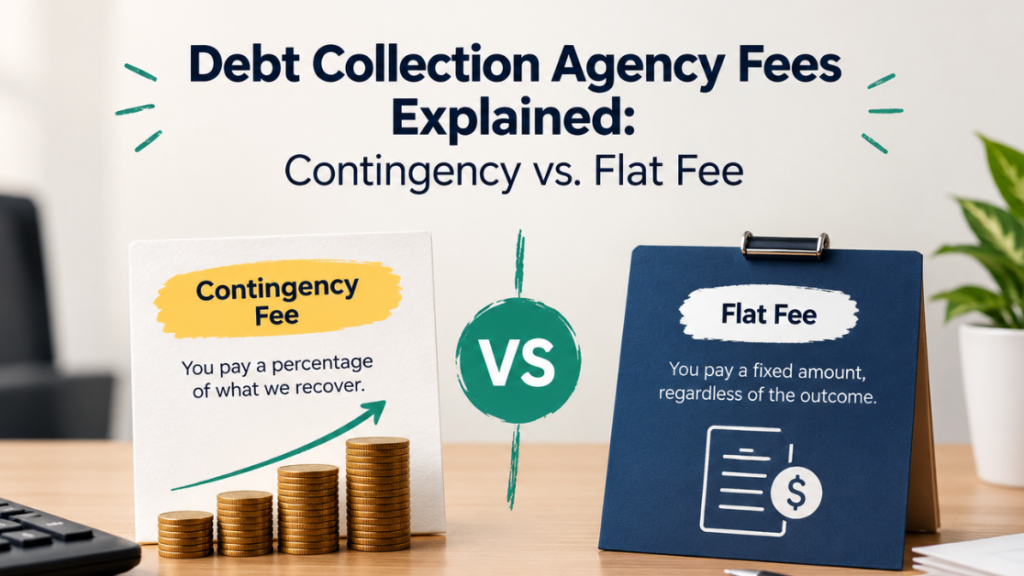
Contingency agencies charge a percentage of whatever they recover, commonly in the 10% to 50% range depending on debt age, balance size, and complexity, and they collect nothing if they don’t collect for you.
This pricing structure is really just another way of answering how do collection agencies work: their revenue depends entirely on results. Some agencies offer flat-fee arrangements instead, a fixed cost per account regardless of outcome, which shifts more risk onto the creditor but offers cost predictability.
Collections law firms and debt buyers operate on entirely different economics, as described above, one on a legal-fee-plus-contingency basis, the other by simply purchasing the debt outright.
Why Compliance Infrastructure Matters More Than It Seems
Every step in how do collection agencies work touches compliance in some way: verifying debt validity, timing and frequency of contact, disclosure requirements, documentation of every interaction. For consumer debt specifically, this isn’t optional structure, it’s federal law, enforced in part by the Consumer Financial Protection Bureau, and a violation exposes both the agency and, potentially, your business to real liability.
This is a meaningful part of what separates a well-run agency from a risky one: whether compliance is something checked periodically, or something built into every call, text, and email as it happens. Real-time monitoring catches problems before they become violations; after-the-fact review only catches them after the damage is done.
Frequently Asked Questions
The questions below dig into how do collection agencies work in more specific, situational terms.
A collection agency contacts debtors on a creditor's behalf to recover unpaid balances, usually in exchange for a percentage of what's collected. The three main models are contingency agencies, collections law firms, and debt buyers, and each affects who owns the debt and how you get paid.
Most contingency-based collection agencies charge between 10% and 50% of the amount recovered, depending on the age of the debt, the balance size, and how difficult the account is to collect. Some agencies also offer flat-fee pricing instead of a percentage.
If an agency doesn't recover the debt within its agreed placement period, the account is typically either returned to the creditor, escalated to legal action, or placed with a different agency. Placing an account with an agency isn't a permanent commitment.
Most collection agencies work debt on a contingency basis and never take ownership of it. Debt buyers are a separate model. They purchase the debt outright, usually for a small fraction of its value, and keep whatever they recover afterward.
Yes. Collection agencies working consumer debt must follow the Fair Debt Collection Practices Act (FDCPA), which sets rules on contact timing, frequency, and disclosure. Commercial debt collection isn't bound by the FDCPA but still falls under general anti-fraud and anti-harassment laws.
Final Thoughts
“Collection agency” like Kollecta covers three genuinely different business models, and knowing which one you’re dealing with, and which one actually fits your situation, is the first real decision in this process. For most small businesses working reasonably fresh accounts, a contingency agency is the right starting point: no upfront cost, aligned incentives, and a clear, mechanical process from placement to resolution.