Most explanations of the debt collection process only cover one piece of it: the agency’s process, the legal stage, or just the early reminders. Rarely does anyone lay out the full arc of the debt collection process in one place: what happens from the moment a payment is missed through internal follow-up, agency placement, and, in rare cases, legal action.
Here’s the complete debt collection process along with a timeline, stage by stage, with the day ranges businesses actually work within.
The Full Timeline at a Glance
| Days Past Due | Stage | What Typically Happens |
|---|---|---|
| 0–30 | Current / Early Reminder | Friendly reminders, invoice resent, no real “collections” activity yet |
| 30–60 | Delinquent | Direct calls, documented emails, tone becomes more deliberate |
| 60–90 | Formal Escalation | Demand letter sent, internal efforts largely exhausted |
| 90–120 | Agency Placement | Account placed with a collection agency for active recovery |
| 120–180+ | Extended Recovery / Legal Review | Continued agency efforts, skip tracing if needed, litigation considered for larger balances |
| 180+ | Resolution or Write-Off | Debt is paid, settled, escalated to court, or written off as uncollectable |
The exact windows shift somewhat by industry and debt type, but this sequence, and the rough day ranges, holds across most consumer and commercial accounts.
Stage 1: Days 0-30, Current and Early Reminders
This stage isn’t really “collections” in the way most people mean it, it’s normal accounts receivable follow-up. A payment becomes overdue, and the creditor sends a reminder: a resent invoice, a short automated email, sometimes a soft-touch phone call. Most accounts resolve here. An invoice going unpaid for a week or two is far more often an oversight, a misdirected email, or a delayed approval, than an unwillingness to pay.
Stage 2: Days 30-60, Delinquency
Once an account crosses 30 days past due, the tone shifts. This is where genuine follow-up begins: direct phone calls, emails that clearly state the amount owed, and, critically, documentation of every attempt. Any promises the customer makes (“I’ll pay by Friday”) should be recorded in writing. This documentation matters twice, it sometimes prompts payment on its own, and it becomes essential evidence if the account escalates later.
Stage 3: Days 60-90, Formal Escalation
By 60 to 90 days, if the account still hasn’t resolved, most businesses send a formal demand letter, a written notice stating the balance owed, the original due date, and the consequences of continued nonpayment. This is also the point where a business should start evaluating whether the account is a candidate for outside help: is the customer entirely unresponsive, has a payment plan been broken, is the balance large enough to justify an agency’s fee. For a plain-language overview of what collectors are and aren’t allowed to do at this stage, the Consumer Financial Protection Bureau’s debt collection resources are a useful reference point.
Stage 4: Days 90-120, Agency Placement
Most guidance across the industry converges on 90 days past due as the point where placing an account with a collection agency makes sense. At this stage, an agency takes over active recovery: verifying the debt, contacting the debtor directly, and negotiating payment or a settlement. Recovery odds are meaningfully better here than they’ll be later, industry data puts the odds of successful recovery at roughly 69% at the 90-day mark, a number that drops steadily the longer an account ages.
Stage 5: Days 120-180+, Extended Recovery or Legal Review
If standard outreach hasn’t resolved the account, recovery efforts intensify. This can include skip tracing to locate a debtor who’s become unreachable, and for larger balances, evaluating whether legal action makes sense. Litigation is generally reserved for cases where the balance justifies the cost, standard efforts have been exhausted, and the debtor has shown no willingness to engage. It’s a slower, more expensive path, and it typically ends any chance of preserving the relationship.
Stage 6: 180+ Days, Resolution or Write-Off
Eventually, every account reaches an endpoint: it’s paid in full, resolved through a settlement, escalated through the courts to a judgment, or written off as uncollectable. By this point, recovery odds have dropped substantially, industry data puts the odds at roughly 21% by the one-year mark, which is part of why earlier action in the timeline matters so much.
What Happens to Credit Reporting Along the Way
For consumer debt specifically, credit reporting can enter the picture once an account is delinquent, and often becomes more likely once it’s placed with a third-party agency. A debt collections entry can remain on a credit report for years, which is one of the reasons debtors often become more responsive once an account reaches this stage in the debt collection process, even after ignoring earlier reminders entirely. For commercial debt, credit bureau reporting works differently and is generally tied to the business’s commercial credit profile rather than a consumer report.
Businesses that want to understand the legal guardrails around contacting debtors and reporting debt can review the FTC’s Fair Debt Collection Practices Act guidance, which outlines what collectors can and cannot do at each stage.
Why the Early Stages Matter as Much as the Late Ones
It’s tempting to think of the “real” debt collection process as starting once an agency gets involved, but the earlier stages materially affect the outcome. Accounts with a clean, documented history of reminders and demand letters are easier and faster for an agency to work than accounts with a thin or inconsistent record. Skipping straight to placement without the earlier documented steps doesn’t just risk looking premature to the debtor. It can leave an agency working with less to go on.
Frequently Asked Questions
There's no fixed length, but most accounts that are going to resolve do so within the first 90 days. Once an account moves into agency placement or legal review, the debt collection process can stretch on for many months, especially if skip tracing or litigation becomes necessary.
Most businesses place accounts with an agency once they hit roughly 90 days past due, after internal reminders, calls, and a formal demand letter have failed to resolve the balance. This is the point in the debt collection process where recovery odds are still relatively strong, which is why timing the handoff matters.
No. Most overdue invoices resolve during the early reminder stage and never require anything beyond a friendly follow-up. Formal collections activity is typically reserved for accounts that remain unresolved well past the original due date.
Technically, yes, but it's rarely the efficient choice. Courts and most legal advisors expect to see a documented history of reminders, calls, and a demand letter before litigation. Skipping the earlier stages of the debt collection process can weaken a case and increase costs without improving the odds of recovery.
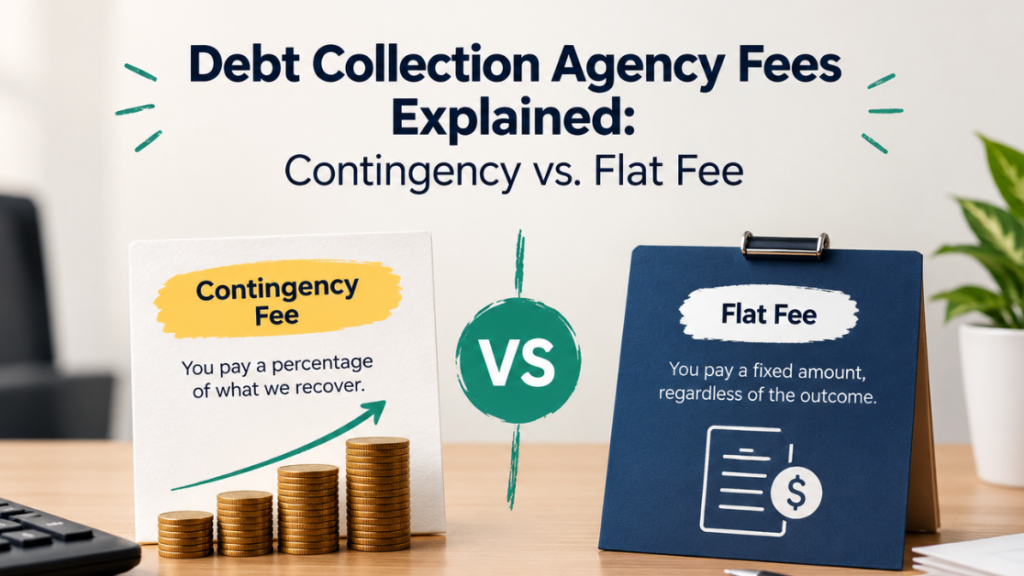
The internal process (reminders, calls, and demand letters) is handled directly by the creditor's own staff and is generally lower-cost but limited in reach. A third-party agency has more tools (skip tracing, negotiation experience, and sometimes legal resources) but takes a fee or percentage of what's recovered, which is why it's usually reserved for accounts that internal efforts couldn't resolve.
Bottom Line
At Kollecta, we see the debt collection process as a sequence with a logic to it, not a single event: early stages designed to resolve genuine oversights quickly and cheaply, later stages designed to apply more structured pressure once it’s clear the account needs it. Understanding the full debt collection process, not just the piece your business happens to be dealing with right now, makes it easier to know where an account actually stands and what reasonably comes next.