Debt collection is a set of activities undertaken to recover unpaid money after the customer, client or business has not paid by the agreed upon due date.
The basic definition is that.
However, debt collection is not a one-off process, but a series of processes with specific terminology, different players and different steps depending on the stage of the collection process.
Knowing that, and everything that entails, clarifies everything that follows (when to call it an escalation, whom to involve, what happens), etc.). This guide walks through each stage, the terminology attached to it, and where a modern debt collection agency fits into the process.
The Debt Lifecycle, Stage by Stage
Every unpaid balance moves through roughly the same stages, though not every account reaches the later ones.
Current. There is no invoice or payment due. This is not a debt collection matter, it is merely normal accounts receivable.
Past due. The due date has passed, but only recently. Most businesses treat this as a normal part of doing business and handle it with friendly reminders rather than anything resembling collections.
Delinquent. The account is owed for at least 30 – 90 days, and needs more conscious follow-up: direct calls, a documented email trail, a formal demand letter. This is where debt collection, in the real world, truly starts, even if it’s still being done in-house.
Default, or charge-off. If an account is not paid after a certain time (typically 90-180 days), it can be officially recorded as a loss on the lender’s accounting books, also known as a charge-off. Importantly, a charge-off doesn’t mean the debt disappears or is forgiven, it’s an internal accounting classification. The creditor (or subsequent owner of the debt) may still try to collect.
Collections. Most people refer to this when they hear the word ‘debt collection’, the account is actively being collected by the original creditor’s collection team or a third party. It is in this context that formal outreach and negotiation, and structured recovery efforts occur.
Resolution or write-off. The account is either settled or paid off or it’s deemed uncollectible. There are also some accounts that will move on to legal action before this last step.
First-Party vs. Third-Party Collection
The distinction is quite helpful and rarely discussed, and it can be done in your name or someone else’s name.
First party means a group that is pursuing the debt on a first party’s behalf or the original creditor himself. Even though most people don’t call this first party collection, your own accounts receivable team calling a client about an overdue invoice is first party collection.
Third party collection is when a different collection agency assumes responsibility for the collection and contacts the debtor under its own name instead of yours. The common misconception of the termination of a contract because it was sent to collections is that this is the final event in the process, and it usually occurs after first party calls have been exhausted.
It’s not just a matter of words: with consumer debt, once it’s a third party that enters the picture, more terms of the FDCPA are applicable to the conduct of that third party, but not to the internal collection efforts of the original creditor.
Key Terms You’ll Actually Encounter
A brief and helpful glossary:
- Creditor: The Individual or business that owes money.
- Debtor: The person that owes it.
- Delinquency: A state of being delinquent, usually before the account goes into formal collections.
- Charge-off: An accounting loss of a debt, which does not cancel out the debt or the creditor’s right to the debt.
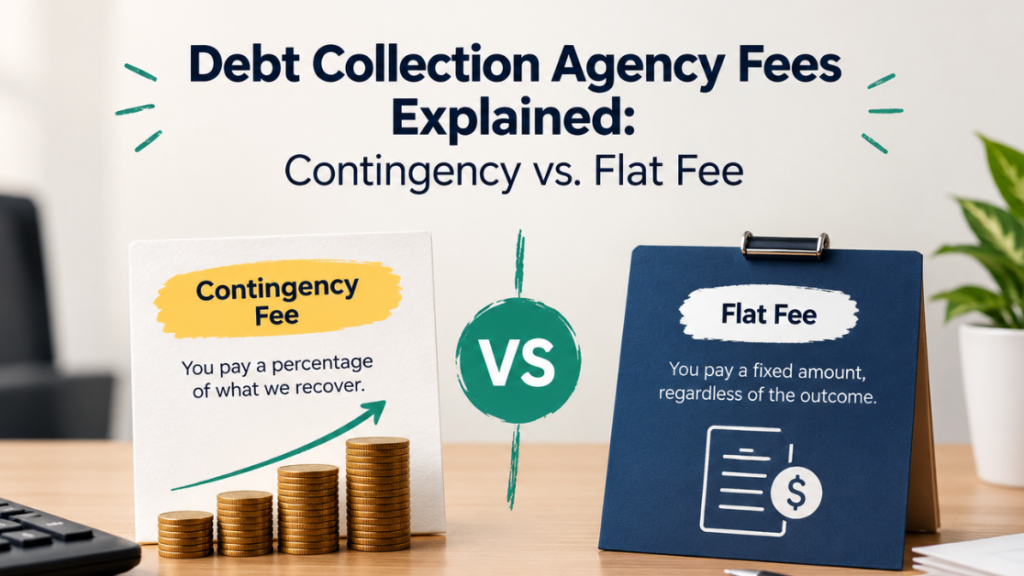
- Contingency fee: The percentage that a collection agency charges, only if it is able to recover it.
- Validation notice: A written notice that a third-party collector must provide to validate consumer debt, under the FDCPA.
- Statute of limitations: A time limit, determined by state and debt type, for a creditor to sue to collect a debt.
- Skip tracking: The activity of trying to find a debtor that is hard to reach or has relocated.
- A charge-off vs. Collections: They may sound similar, but they are different; a charge-off is an internal accounting activity and Collections is an active recovery action. Debt can be charged off and in collections at the same time.
What Debt Collection Isn’t
A few common misconceptions worth clearing up:
- It’s not automatically aggressive or hostile. Modern collections, particularly with reputable agencies, relies more on structured communication and negotiation than pressure tactics. Aggressive, threatening conduct is actually restricted by law for consumer debt.
- It’s not the same as a lawsuit. Most of the collection activity is conducted by calling, sending letters and negotiating – never in court. Litigation should not be taken as a first step, but is a late-stage option.
- It’s not instant. Resolution time can take weeks even if it has been placed with an agency, depending on the debtor’s responsiveness, and the type of account.
- It’s not a sign that you’ve lost the connection with the customer. In commercial and B2B situations, many businesses persist in doing business with a customer even after an account is collected if the failure to pay was because of a temporary cash flow problem and not because the customer has become so displeased with the business that they refuse to pay.
Consumer vs. Commercial Debt Collection
The core distinction here is legal: consumer debt (owed by individuals for personal, medical, or household purposes) is governed by the FDCPA and related regulations, while commercial debt (owed by one business to another) generally isn’t. This changes the tools, tone, and rules available to whoever is collecting, and it’s worth knowing which category your unpaid accounts fall into before deciding how to proceed.
Why This Matters for Your Business
Understanding debt collection as a lifecycle, rather than a single dreaded event, changes how you approach overdue accounts. It means recognizing that a 15-day-late invoice isn’t a collections problem yet, that a 90-day-old account probably is, and that the terminology creditors and agencies use (delinquent, charged off, placed, contingency) has specific meaning that affects your options at each stage.
Frequently Asked Questions
There's not a single trigger but, practically, when an account is no longer part of the normal reminder process and is part of a more formal and targeted follow-up process, usually 30-90 days past due, it is in debt collection mode, whether internally or with a debt collection agency.
No. A charge-off is an internal bookkeeping classification that indicates that the debt is a loss. The creditor (or subsequent owner of the debt) may still pursue the collection.
A debt collector is someone who works a debt for the original creditor, and receives a fee or percentage of the debt collected. A debt buyer is a third party who acquires the debt, and thus can claim the debt as his, and then claim whatever he collects.
No. Consumer debt is covered by the FDCPA and other regulations, commercial debt is not and other rules, tools and expectations apply to each.
Not usually, and not at first. Most debt collection resolves through direct outreach, negotiation, or a third-party agency, without litigation. Legal action is typically a later-stage option reserved for larger balances or completely unresponsive debtors.
Final Thoughts
Debt collection isn’t a single awkward phone call, it’s a process in which there is real structure, stages, terminology, and rules. By understanding where an account is in that cycle, and what “delinquent” or “charged off” really means to creditors and agencies, you will be in a much better position to decide what to do next and when.
Kollecta serves businesses from the early stage of delinquency to active recovery, and works on a contingency fee basis, meaning there is no upfront fee. If you’re not sure where you’re at and what choices you have, Kollecta’s team can lead you through.