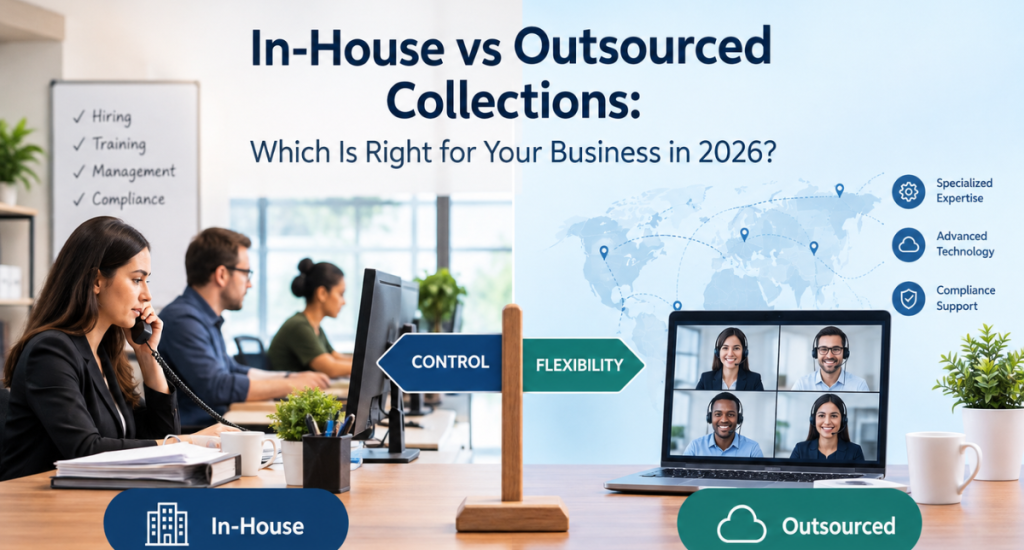

All companies that provide credit will eventually face the same issue: when clients fail to pay, who handles collections? Until recently, the standard answer was “our team.” Yet in 2026, with compliance constraints becoming more stringent, cash flows tightening, and clients expecting to communicate digitally, the question of In-House vs Outsourced Collections becomes one of the key decisions a CFO faces.
There is no universally correct answer, as the ideal choice depends on business volume and margins, industry sector, and risk tolerance. This publication helps compare these two models objectively to make the right decision with ease.
What Does In-House vs Outsourced Collections Actually Mean?
With in-house collections, your company’s employees manage late payments in-house. This generally involves sending notices and reminders, making calls and negotiating payment arrangements, and deciding when to escalate matters. You control the entire process, including the tools you use and the relationships you build.
With outsourced collections, you work with an outside debt collection agency that collects overdue payments for you. These agencies use their own staff, technology, methods, and compliance practices, and they charge fees based on how much money they collect for you.
Most companies utilize a combination of these methods. They manage their early reminders in-house and then turn their accounts over to an agency after a certain amount of time, for example, 60–90 days after the due date.
Is In-House Collections the Right Strategy?
Keeping collections internal has real advantages, especially for companies with close customer relationships.
Direct control over tone and messaging is the biggest one. Your team knows your customers, your products, and your brand voice, so they can handle sensitive conversations with context an outsider might lack. Faster early intervention is another benefit, since a customer who is five days late often just needs a friendly nudge from someone they already know. And for businesses with very low delinquency volumes, a part-time internal effort can be enough.
But the drawbacks are significant. Collections is a specialized skill, and most internal finance teams are generalists juggling it alongside billing, reconciliation, and reporting. Staff turnover in collections roles is notoriously high. Technology like automated dialers, payment portals, and account prioritization tools is expensive to build or license. And every conversation carries compliance exposure that your business alone must manage.
Is Outsourcing Collections the Right Strategy?
A professional agency changes the economics and the expertise behind your recovery efforts.
Having specialized skills is an advantage. Because professional debt collectors focus on overdue payments, they know how to overcome objections, resolve disputes, and support clients experiencing financial hardship. Agencies are also responsible for compliance, as professional collection agencies implement regulations such as the Fair Debt Collection Practices Act (FDCPA), Regulation F, and the Telephone Consumer Protection Act (TCPA), which minimizes risk. Scalability also matters, as the agency can handle increases in delinquency without requiring the client to recruit and train new employees. Furthermore, with contingency fees, clients pay only when payments are collected.
When it comes to outsourcing, the main issue of concern is customer experience. Traditional agencies have a reputation for using hard-selling techniques that led to negative publicity. This is a legitimate concern, thus stressing the importance of selecting the right collection agency.
The Real Cost Side of In-House vs Outsourced Collections
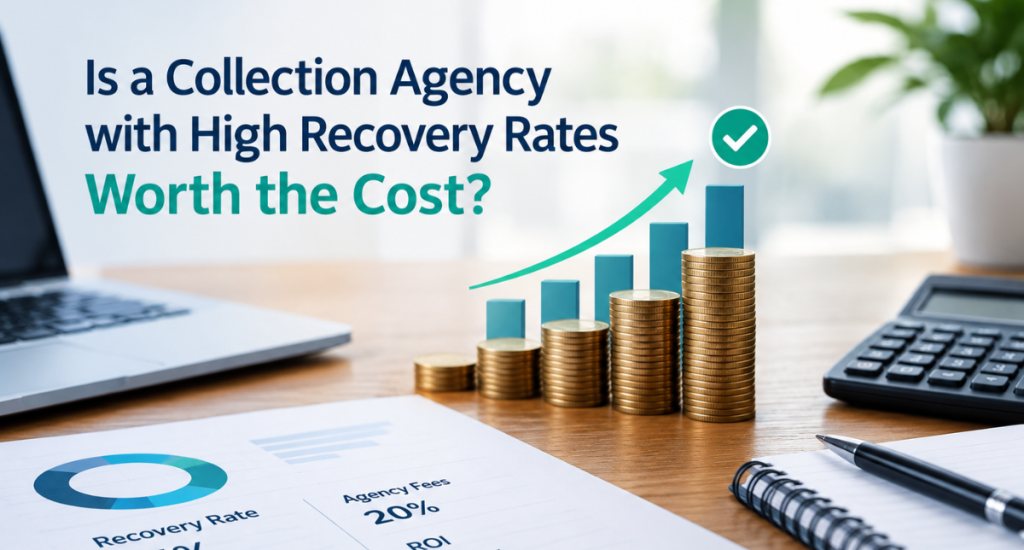
When businesses compare costs, they often look only at the agency’s contingency fee and conclude that in-house is cheaper. That comparison is incomplete.
The true cost of an internal team includes salaries and benefits, recruiting and training, collection software and phone systems, payment processing infrastructure, management time, legal review, and the cost of compliance mistakes. There’s also an opportunity cost: every hour your finance team spends chasing late payments is an hour not spent on forecasting, analysis, or growth.
Outsourced pricing is usually a percentage of recovered funds, which varies based on account age, balance size, and volume. Because older debts are harder to collect, fees rise as accounts age, which is exactly why handing off accounts early often produces better net recovery.
The smart way to approach the cost side of In-House vs Outsourced Collections is to compare net dollars recovered, not just expenses. A cheaper process that recovers less can easily cost you more.
In-House vs Outsourced Collections at a Glance
| Factor | In-House | Outsourced |
|---|---|---|
| Upfront investment | High (staff, software, training) | Low (usually contingency-based) |
| Control over messaging | Full | Shared, depends on partner |
| Compliance risk | Carried entirely by you | Largely managed by the agency |
| Scalability | Limited by headcount | Scales with volume |
| Expertise | Varies with team experience | Specialized and dedicated |
| Best for | Low volume, early-stage reminders | Aged accounts, high volume, complex cases |
Why Compliance Tips the Scales in 2026
The importance of compliance has grown significantly when deciding between In-House Collections and Outsourced Collections. Regulations governing phone calls, emails, text messages, disclosure requirements, and dispute resolution are very strict. One phone call made at the wrong time or a text message sent without prior consent can put the organization at risk of incurring high legal costs.
For internal teams, however, this can be too demanding, especially for organizations where employees require constant training and up-to-date documentation.
When In-House Makes More Sense
There’s no universal winner in In-House vs Outsourced Collections, and some businesses genuinely are better served keeping things internal. That tends to be the case if your delinquency volume is very low, if your accounts are mostly just a few days late and resolve with a reminder, if you have long-standing personal relationships with a small number of clients, or if you already have an experienced collections team with modern tools.
When Outsourcing Is the Smarter Move
Outsourcing is likely to be successful in situations where accounts are overdue by 60 to 90 days, when you have limited internal support, when the number of delinquent accounts exceeds the number of employees, when you operate in many different states or industries with different regulations, or when your efforts to collect have reached a standstill.
The Hybrid Model: Often the Best of Both
For many businesses, the most practical answer to In-House vs Outsourced Collections is “both.” Your team handles the first-touch reminders while the relationship is warm, and a trusted agency takes over once an account crosses a defined threshold. This keeps early communication personal while ensuring harder cases get specialized attention before they become uncollectible.
The key is setting clear handoff rules, such as account age, balance size, or number of failed contact attempts, so accounts don’t sit in limbo losing value.
What to Look for in a Collections Partner
Your choice of outsourcing partner will affect your results and your business’s reputation. The right agency pays close attention to clients, ensures compliance at every step of the workflow, uses multiple communication channels instead of relying only on phone calls, provides up-to-the-minute reports, and operates on performance-based pricing.
Kollecta is a modern agency that builds on what came before. Kollecta describes itself as a collection agency that uses technology while serving customers. Moreover, the company’s famous Stash Theory lets you apply new strategies to help businesses recover debts without damaging client relationships.
Final Verdict: Why Outsourcing Deserves Serious Consideration
The In-House vs Outsourced Collections decision comes down to three questions: How much are overdue accounts costing you today? Do you have the expertise and systems to recover them compliantly? And can your current approach scale as your business grows?
For leading businesses in 2026, the honest answers to these questions point towards outsourcing. You bring on a collections partner to take what can be a time-consuming and risky activity off your plate and replace it with specialists, proven recovery techniques and compliance controls in every conversation. Your finance teams return to their core task of forecasting and developing business, your cash position improves, and you hire a person or agency contingent on the results achieved. Outsourcing is not about losing control. It’s about handing over your receivables to someone who knows how to ensure you get paid.
The most important part of any collections implementation is choosing a reliable partner, and this is where Kollecta stands out from the competition. Other companies still rely on old-school, aggressive collection methods, while Kollecta uses seasoned specialists alongside AI-driven automation. It offers multiple collection channels and instant reporting that maintains a human touch. This leads to faster collection processes, better visibility into your portfolio’s performance, and more effective customer retention.