Debt collection compliance has never been something anyone in the industry could simply ignore, and 2026 will be no different. Regulations on debt collection will continue to be clarified through regulatory actions and court decisions. States will keep developing their laws in this area, while consumers will become more aware of their rights. For debt collectors and creditors, it’s no longer just about avoiding penalties; it’s also about protecting their business’s reputation, repayment rates, and client relationships.
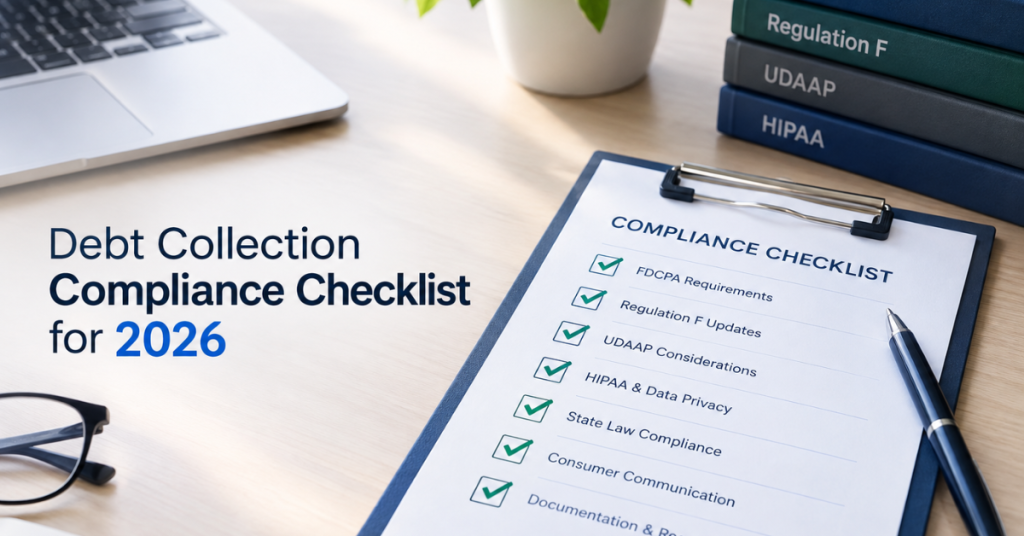
This debt collection compliance checklist helps every collection agency focus on the key objectives it must accomplish in 2026. Use it for internal audits, assessing service providers, or legal consultations.
1. Confirm You Are Meeting FDCPA Fundamentals
The Fair Debt Collection Practices Act is the foundational basis of consumer debt collection in the United States. However, even the most experienced team needs to revisit the fundamentals regularly.
- The collector introduces themselves and states that they are trying to collect the debt in all communications (“Mini Miranda”).
- They do not use harassing and/or abusive language while making calls and sending letters, texts, or emails.
- They do not create a false or misleading impression regarding the amount due, the consequences of legal action, or the collector’s identity.
- The calls are made within convenient hours (i.e., typically after 8 a.m. or before 9 p.m. in the consumer’s time zone).
- Information provided to third parties refers only to the consumer’s whereabouts and includes no information about the debt collector.
- Communication stops (except for permitted notices) when a consumer requests it in writing or is represented by an attorney.
2. Review Your Regulation F Procedures
Regulation F, which implements the FDCPA, modernized many collection rules for today’s communication channels. Its requirements are now well established, which means regulators expect full compliance with no excuses.
- Call frequency limits: Your systems enforce the presumption of no more than seven call attempts within seven consecutive days per debt, and no calls within seven days after a phone conversation about that debt.
- Validation notices: All necessary information is included in the notices (date, amount, rights to dispute the notice, response time period). Many collection agencies try to stick to the CFPB-developed form because it feels safe.
Electronic communication: All correspondence through email and SMS includes clear, simple opt-out options.
Limited-content voicemails: Voicemail scripts follow the restricted-content format, so third parties do not accidentally listen to them. - Social media: Debt collectors do not communicate debts publicly via social media at any point, and they clearly identify themselves when communicating via direct messages.
- Passive debt collection: No information about the debt is reported to the credit bureaus until the person is contacted and has received enough time to dispute the debt.
3. Check TCPA Compliance for Calls and Texts
The Telephone Consumer Protection Act continues to draw many lawsuits, and statutory damages can grow quickly.
- Consent is documented in records and can easily be retrieved for calls/texts sent using autodialers and pre-recorded messages.
- Revocation of consent is immediately honored, no matter how the consumer does it.
- Reassigned number checks are performed frequently to prevent contacting someone other than the debtor.
- Texting programs follow opt-out keywords and carrier requirements.
4. Verify Credit Reporting Accuracy Under the FCRA
If your organization furnishes data to credit bureaus, accuracy and dispute handling are essential.
- Reported balances, dates, and account statuses match your records.
- Disputed accounts are flagged as disputed.
- Investigate disputes received through bureaus (via e-OSCAR) and directly from consumers within required timeframes.
- Update paid or settled accounts promptly.
5. Keep Up With State Laws and Licensing
State requirements are often stricter than federal ones, and they change frequently. This is one of the areas where agencies most often fall behind.
- Licenses and bonds are current in every state where you collect.
- Include state-specific disclosures (for example, in California, New York, Massachusetts, and Colorado) in letters and scripts.
- State call and contact frequency limits are applied where they are stricter than Regulation F.
- Review interest and fee rules for each state’s caps and restrictions.
- Update statute-of-limitations tables, including time-barred debt disclosures where required.
6. Handle Medical Debt With Extra Care
Medical debt is garnering more attention among regulators, lawmakers, and the public. A federal rule intended to eliminate medical debt from credit reports was struck down in court in 2025. However, several states have enforced their own medical debt rules, and different credit reporting agencies have implemented their own voluntary limits.
- Your team knows which states restrict reporting or collecting medical debt, and how.
- Where required, confirm charity care and financial assistance eligibility with healthcare clients before collection begins.
- Balances are verified carefully, since insurance adjustments frequently change what is owed.
7. Strengthen Data Security and Privacy
Collection agencies handle sensitive personal and financial information, which makes them attractive targets for cybercriminals.
- A written information security program is in place, consistent with the FTC Safeguards Rule under the Gramm-Leach-Bliley Act.
- Access to consumer data is limited to employees who need it.
- Data is encrypted both in transit and at rest.
- Vendors and third parties are vetted for security practices.
- A breach response plan exists and has been tested.
8. Train Your Team and Monitor Conversations
Policies only work if people follow them. Ongoing training and quality assurance catch problems before they turn into complaints.
- Collectors complete compliance training at onboarding and at least annually.
- Record calls (with proper disclosures) and regularly review a sample.
- Compliance reviews scripts and templates before use.
- Track, categorize, and use consumer complaints to improve processes.
9. Document Everything
In a dispute or regulatory exam, your records are your best defense.
- Log every contact attempt, consent, dispute, and payment with dates and details.
- Retain records for the required periods (Regulation F requires at least three years for many records).
- Your system can produce a complete account history quickly when asked.
10. Treat Consumers With Respect
Respect and compliance are inseparable. Customers who feel respected are more likely to take action by engaging, creating payment plans, or resolving their debts. That is why many modern agencies like Kollecta build their collection strategy on transparent, respectful communication. A professional tone helps ensure compliance and improves the debt recovery process.
- Payment options are flexible and clearly explained.
- Consumers can easily reach a real person to ask questions.
- Hardship situations are handled with empathy and documented appropriately.
Choosing a Debt Collection Compliance Partner
For many organizations, handling all of these activities internally is difficult, and partnering with a professional agency can help. When evaluating a partner, ask about their licenses, training, dispute-resolution processes, and how they monitor collector communications. A licensed agency like Kollecta has clear answers to those questions.
Final Thoughts
In 2026, debt collection compliance comes down to three essential components: understanding the regulations, automating enforcement, and applying fairness to every consumer. Review this debt collection compliance checklist annually, and again whenever federal or state laws change.