Compliant Collections Aren’t Optional. They’re the Foundation.
Any business that entrusts its collections to an agency is placing something more valuable than the balance itself, its standing with customers, into the hands of that agency. If compliance is mishandled, one bad call or a text sent at the wrong time can result in a regulatory complaint, a lawsuit, or a customer who stops coming back. Yet if compliance is managed properly, collections can serve as evidence that the business deals fairly with people, even though they do owe money; that is the reason why FDCPA debt collection compliance should be one of the first items that any business examines before entrusting collections to an external partner.
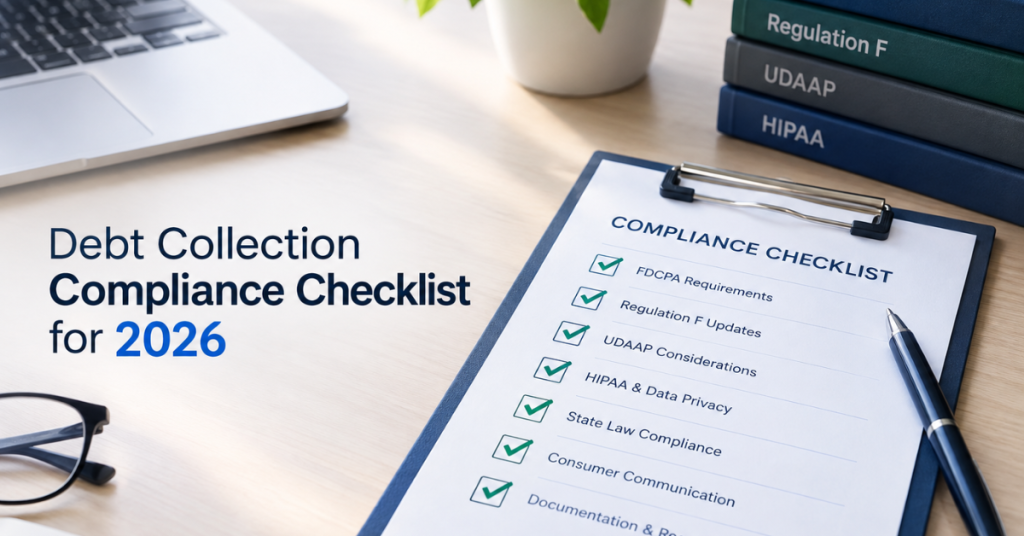
The specific requirements of the Fair Debt Collection Practices Act (FDCPA) and the standards to apply when assessing an agency that takes the act seriously are as follows.
What Is the FDCPA (and Why Regulation F Matters)
The federal law known as the FDCPA specifies the rules regarding the way in which third-party debt collectors can contact and pursue consumers; it is primarily enforced by the Consumer Financial Protection Bureau (CFPB), which in 2021 finished Regulation F, a set of amended rules that extended the FDCPA protections to cover new forms of communication such as email and text messages.
Regulation F did not eliminate the FDCPA; instead, it clarified and strengthened the way the law applies in a world where most communication now happens by phone or letter.
The Core Rules To Follow for FDCPA Debt Collection Compliance
The contact hours require that collectors not call before 8 a.m. or after 9 p.m. in the consumer’s local time zone; in several states stricter hours have been set, and a compliant agency will follow the rule that provides greater protection.
The 7-in-7 rule states that a collector may contact a consumer about a particular debt no more than seven times within any seven-day period that is moving forward. After having undertaken a live conversation with the consumer, the collector must wait an additional seven days before making another call regarding that debt, unless the consumer agrees to proceed otherwise.
The right to ask for cessation: if a consumer sends a written request asking the collector to stop, the collector must at once comply, with the only exceptions being cases such as confirming that the request has been received or letting the consumer know that a certain legal step is being taken.
When collectors make their first contact with a consumer they must send a written notice confirming the debt, and the consumer must be given a period of 30 days during which to contest the debt before any further collection actions can be carried out without permission.
Email and Text Rules Under Regulation F Compliance
There are particular requirements associated with both email and text messaging. Before contacting a consumer through either of these channels, a collector must obtain their consent and the consent for text messages must be regularly renewed, with a check made to ensure that the number hasn’t been given to a different person. Each email and text message also has to provide the consumer with a simple and straightforward method by which they can unsubscribe from that channel entirely.
It is in this area that outmoded collection methods pose the greatest risk, since a process designed for making phone calls and sending letters does not simply become an acceptable system for text or email communication.
Time-Barred Debt Disclosures
Even though debt which has passed its statute of limitations can sometimes still be collected, consumers cannot be deceived about it. To ensure that consumers understand their legal position before deciding how to react, the CFPB’s rules mandate certain disclosures whenever an organization is collecting on time-barred debt. Failing to make such a disclosure is one of the more frequent ways in which debt collectors come into regulatory difficulty. Getting this disclosure right is a core piece of consumer protection compliance that many agencies overlook.
What Happens When Agencies Get It Wrong
Enforcement has not decreased; it has changed. While the CFPB has reduced certain aspects of its direct supervision, the FTC and the individual states have taken over. The FTC’s recent actions against collectors for making false threats to arrest them or to sue them, and for misrepresenting their association with government loan schemes, led to payouts amounting to tens of millions of dollars.
Moreover, states such as California, Maryland, Massachusetts, and New York have also expanded their own licensing of debt collection companies and increased enforcement in this area. These enforcement trends make clear that debt collection laws are only getting stricter at the state level, which makes FDCPA debt collection compliance a bigger differentiator than ever when selecting a partner.
The conclusion that any business should draw when selecting a collection partner is that oversight at the federal, state, and industry levels regarding collection practices will not be ending. Selecting a company that considers compliance as a fundamental aspect rather than something merely done afterwards will protect both the amount recovered and the relationship.
How Kollecta Builds Compliance Into Every Recovery
Kollecta does not carry out compliance just once and then leave it alone; when it comes to any of the ways in which it communicates, whether by means of SMS messages, voice calls, emails, or digital interactions, the rules concerning contact hours, consent, and disclosure are considered right from the start. Treating customers with empathy and concentrating on building a relationship are not only sensible things to do; in fact they are what makes the collection activities defensible and ensures that the company’s reputation is maintained among the people it serves. This is what FDCPA debt collection compliance looks like in practice, a standard held to on every contact, not a checklist completed once.
The Bottom Line
The FDCPA and Regulation F are in place in order that debt collection may remain fair and they will not be abolished. Even if businesses outsource their collections, they still have to be held accountable for the methods employed by the agency, so the agency’s record of compliance is just as important as its recovery rate. Strong FDCPA debt collection compliance is what keeps both the recovery and the relationship protected.
FAQs
At minimum, FDCPA debt collection compliance means following the contact-hour rules, the 7-in-7 contact frequency limit, a consumer's right to cease and desist, a written validation notice within the first contact, and the consent and opt-out requirements for email and text under Regulation F.
The main body responsible for this is the Consumer Financial Protection Bureau (CFPB), while the Federal Trade Commission (FTC) and the individual state regulators are also taking an active part in enforcement, particularly in view of the recent changes to federal supervision.
Collectors must not telephone before 8 a.m. or after 9 p.m. in the consumer's local time zone, and in some states stricter restrictions apply which take priority.
Certainly, Regulation F requires that collectors obtain consumers' consent before contacting them by text or email, mandates that they reacquire that consent from time to time, and must also offer consumers a way to opt out of each message.
Failure may lead to regulatory actions, financial penalties, and legal proceedings by consumers. The recent enforcement actions carried out against collectors who have failed to comply have resulted in judgment orders in the millions, which is the reason why it is important for a company to take a partner's compliance record into account when choosing a collector.