You have sent the invoice and follow-up reminders, but have not received a response. The payment deadline has passed, leaving you with an overdue invoice and an outstanding balance.
This situation is common and can often be resolved with a clear next step. According to the Federal Reserve, roughly four in five small firms face challenges related to collecting customer payments, one of many debt collection industry statistics that show how widespread late payment has become. The key is how you respond when standard follow-up fails.
This guide outlines steps to take when an invoice remains unpaid after initial reminders. If you are sending your first reminder, please see our guide on collecting past due invoices. The following steps explain how to escalate when a client misses the payment deadline and does not respond.
What Counts as an Overdue Invoice
An invoice becomes overdue once the due date passes without full payment. For example, with Net 30 terms, the invoice is overdue on day 31. There is no grace period unless you have provided one in writing.
Distinguish between a past-due invoice, which is overdue, and one that remains unpaid after follow-up. If a client ignores reminders, the delay is likely intentional and may require a new approach.
Most businesses use an accounts receivable aging report to categorize overdue invoices by age: 1 to 30, 31 to 60, 61 to 90, and over 90 days. The longer an invoice remains unpaid, the harder it is to collect. Recovery rates decline significantly after 90 days, so prompt action is essential.
Why Clients Delay Payment
Before escalating, identify the reason for the late payment and tailor your response to address it.
Administrative delays, such as invoices sent to the wrong email, pending approval, or missing from the client’s payment system, are usually resolved quickly once identified.
Other delays may result from cash flow issues, where clients wait for incoming payments before paying you. Some companies also intentionally delay payments to retain working capital.
A lack of response from a client may indicate a dispute, dissatisfaction, concerns about overcharging, or other issues. Identifying the cause enables you to respond appropriately, such as correcting billing errors, offering payment plans for cash flow challenges, or following up more firmly for intentional delays. Understanding the reason for the delay helps you select the most effective solution.
The Step-by-Step Escalation Sequence
If your initial reminder is unsuccessful, escalate the matter through clear, structured stages. Each step should increase urgency, maintain documentation, and preserve the client relationship. This approach also demonstrates good faith if legal action becomes necessary.
Step 1: Send a firm reminder. Reference the invoice number, original due date, amount owed, and days overdue. Set a clear response deadline, typically within 7 days, and include payment instructions. Remain professional and invite the client to share any concerns that may explain the delay.
Step 2: Call the client. Direct communication signals urgency and may clarify the reason for delay. Have invoice details and a desired outcome, such as a firm payment date, ready. Document the conversation, including any commitments and dates. If you reach voicemail, follow up in writing to confirm your call and restate the outstanding amount.
Step 3: Send a formal written notice. If calls and reminders are unsuccessful, issue a written notice that clearly states the debt and outlines consequences for continued non-payment. See below for details on what to include.
Step 4: Escalate to a third party. If internal efforts are exhausted, engage a collection agency or recovery specialist to pursue the debt, allowing you to focus on your business. Further details are provided below.
A structured approach, such as a B2B collection strategy, is essential for successful recovery. Consistency, not aggression, delivers the best results.
Quick note before you escalate further: The following steps involve formal notices and third-party recovery, which may have legal and financial consequences. This article provides general information and does not constitute legal advice. Debt collection regulations differ by state and country, so please consult a qualified professional before taking action specific to your situation.
If you have an invoice beyond the reminder stage, contact us for a complimentary review of your options.
When to Send a Formal Written Notice
A formal written notice serves as the step between informal follow-up and external enforcement. Send it after reminders and calls have failed, usually when an invoice is 60 days overdue, to emphasize the seriousness of the matter.
This document is often called an overdue invoice letter or a formal letter of demand. An overdue invoice letter restates the debt and requests payment. A formal letter of demand warns that further action, such as collection or legal proceedings, will follow if payment is not received by a specified date.
An effective written notice should address four key elements:
- Provide all debt details, including the invoice number, original date, due date, amount owed, and total days overdue. Ensure the information is clear and complete.
- Set a firm payment deadline by specifying a final date instead of making an open-ended request. Ten business days is a standard timeframe.
- Clearly state the consequences if the payment deadline is missed. Outlining next steps differentiates a demand from a standard reminder.
- Maintain a complete record by sending the notice using a method that provides delivery confirmation, such as email with a read receipt or certified mail.
- Use factual, measured language. Avoid statements that could be seen as threats, as these may cause compliance issues. Clearly present the facts, deadline, and consequences, then conclude the notice.
- When to Involve a Collection Agency
If a formal notice is unsuccessful, further pursuit often costs more time than it is worth. At this stage, consider third-party recovery.
A collection agency or B2B recovery specialist pursues the debt on your behalf. Consider factors such as invoice size, days overdue, and the cost of continued internal effort. Debts older than 90 days with substantial balances should be considered for handoff, as the likelihood of recovery declines over time.
When selecting a partner, prioritize both recovery rates and maintaining client relationships. Aggressive tactics may secure payment but risk long-term relationships and compliance. Modern agencies like Kollecta combine efficient recovery with brand protection, using both automated and personal outreach. Please refer to our guide on hiring a collection agency for important questions to consider.
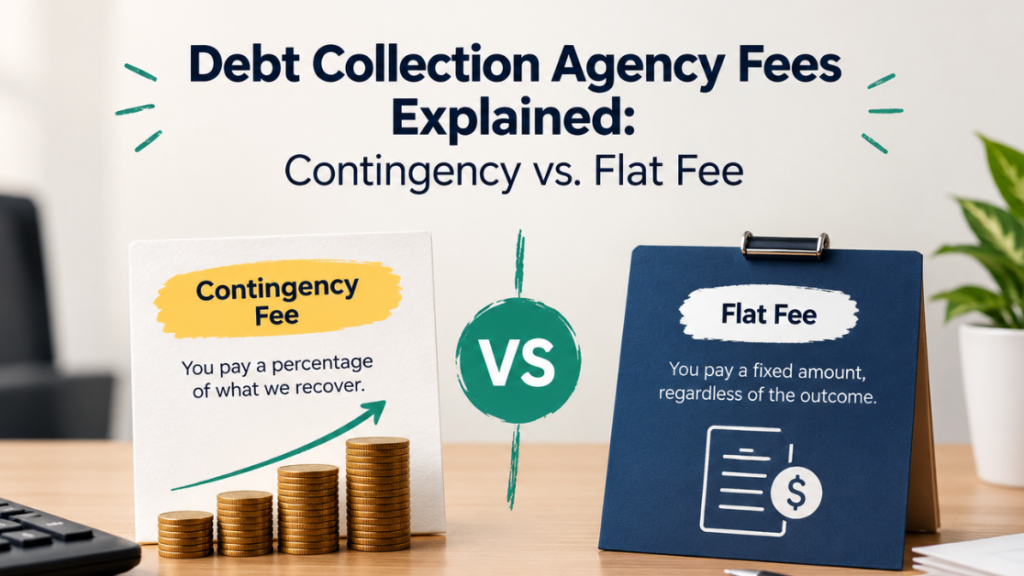
B2B recovery specialists usually work on a contingency basis, taking a percentage of recovered funds and charging nothing if unsuccessful. This arrangement minimizes your upfront risk.