Search “best collection agency” and you’ll mostly find ranked lists naming specific companies, often written by sites that earn a referral fee for the click. The honest answer is less satisfying but more useful: there is no universal best collection agency. The right one depends entirely on your debt type, industry, and account profile. An agency ranked “#1” for medical debt recovery may be a poor fit for B2B commercial invoices, and vice versa.
What actually helps is a real evaluation framework, one that lets you score and compare agencies against your specific situation, and know how to verify what they tell you about themselves rather than taking it at face value.
Why the “Best Collection Agency” Depends Entirely on Fit
Recovery rates vary enormously by specialization. An agency with deep experience in medical debt, navigating insurance complexities and patient financial hardship, can post meaningfully higher recovery rates on medical accounts than a generalist agency would, and the reverse is often true for commercial B2B claims. The best collection agency for a healthcare practice and the best collection agency for a construction company collecting on unpaid invoices are very likely different companies, even if both post strong overall numbers.
This is why evaluating agencies against a generic “best of” list is less useful than evaluating them against your own account profile.
A Real Evaluation Framework for Finding the Best Collection Agency
- Recovery rate for your specific debt type and age. Not the agency’s overall average, their performance on accounts that actually resemble yours. A strong overall recovery rate can mask weak performance in your specific niche.
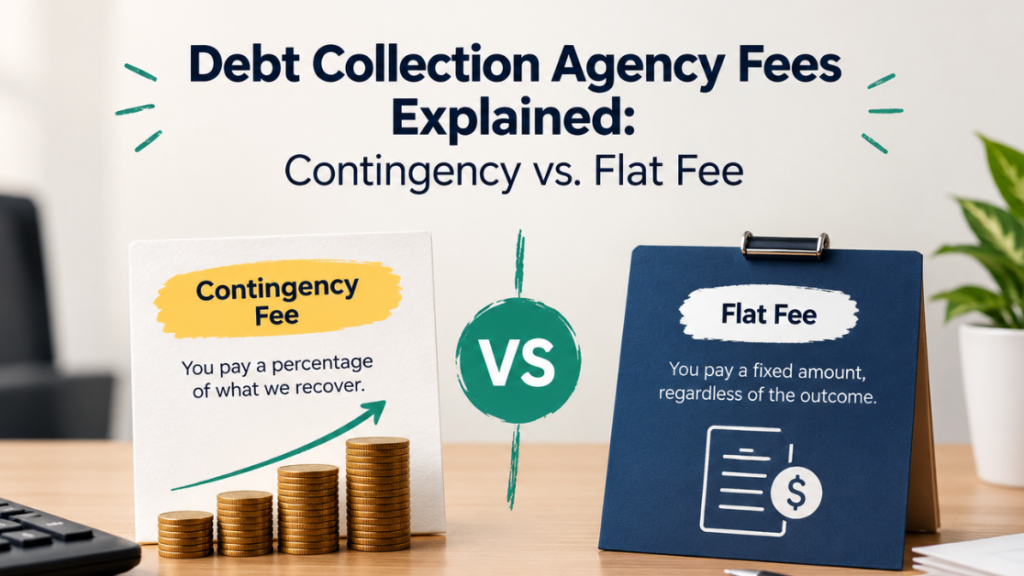
- Fee structure on a net-recovery basis. The lowest quoted percentage isn’t automatically the best deal. An agency charging 25% with a strong track record on your debt type can net you more than one charging 15% with a mediocre one. Ask what you’d actually keep, not just what they’d charge.
- Industry specialization. Does the agency have real, verifiable experience with your specific debt type, healthcare, retail, or B2B commercial, rather than general claims of broad experience?
- Compliance track record. For consumer debt specifically, this matters enormously. Check whether the agency has a pattern of complaints on file with the Consumer Financial Protection Bureau’s public complaint database. A small number of complaints isn’t necessarily disqualifying, but a clear pattern is worth taking seriously.
- Reporting transparency. Can they show you, not just tell you, what real-time account visibility actually looks like? Ask for a live demo of their portal or reporting system during evaluation, not just a description of it.
- Contract terms. Minimum placement periods, cancellation rights, clawback provisions on reversed payments, and whether you’re locked into exclusivity. These terms affect your flexibility long after the sales conversation ends.
- Technology and methodology. How outreach actually happens, calls, texts, email, and whether compliance is built into that process in real time or reviewed only after the fact.
These seven categories together form a practical scorecard for identifying the best collection agency for your accounts, rather than relying on marketing claims alone.
Red Flags to Watch for When Evaluating the Best Collection Agency
- Vague or evasive answers when you ask for recovery-rate data specific to your debt type, rather than a blended overall number.
- Pressure to sign quickly, without time to compare quotes or review the contract closely.
- Reluctance to provide references, or references that are suspiciously generic rather than specific to your industry.
- Inability to clearly explain their compliance process beyond a general assurance that they “follow the law.”
- No clear answer on contract flexibility, cancellation terms, or what happens if a payment is later reversed.
A Practical Process for Comparing Finalists in Your Best Collection Agency Search
- Ask each the same set of questions, so you’re comparing genuinely equivalent answers rather than whatever each agency chose to volunteer.
- Score them against the seven categories above, even informally, rather than relying on gut impression alone.
- Do the net-recovery math for each, using their quoted fee and their actual (not blended) recovery rate for your debt type.
- Check references and the CFPB database before making a final decision, not after.
Frequently Asked Questions
There is no single best collection agency for every small business. The right fit depends on your industry, debt type, and account size, not a generic "best of" ranking. Look for an agency that's upfront about recovery performance by debt type, like Kollecta, so you can judge fit using real data instead of marketing claims.
Choose a collection agency by evaluating recovery rates for your specific debt type, fee structure on a net-recovery basis, industry specialization, compliance history, reporting transparency, and contract flexibility. Score two or three finalists against these categories and verify their claims through references and public complaint databases before signing.
Collection agency fees typically range from 15% to 35% of the recovered amount, depending on debt age, type, and industry. The lowest quoted percentage isn't always the best deal. An agency with a higher fee but a stronger recovery rate on your specific debt type can net you more money overall.
Check the agency's complaint history on the Consumer Financial Protection Bureau's (CFPB) public database, ask for industry-specific references, and request a live demo of their compliance process rather than a general assurance. A pattern of unresolved complaints or vague answers about compliance procedures are red flags.
Medical debt collection requires expertise in insurance complexities and patient financial hardship programs, while commercial (B2B) debt collection requires experience with invoice disputes and business-to-business negotiation. An agency that excels at one may perform poorly at the other, so always ask for recovery-rate data specific to your debt category rather than a blended overall average.