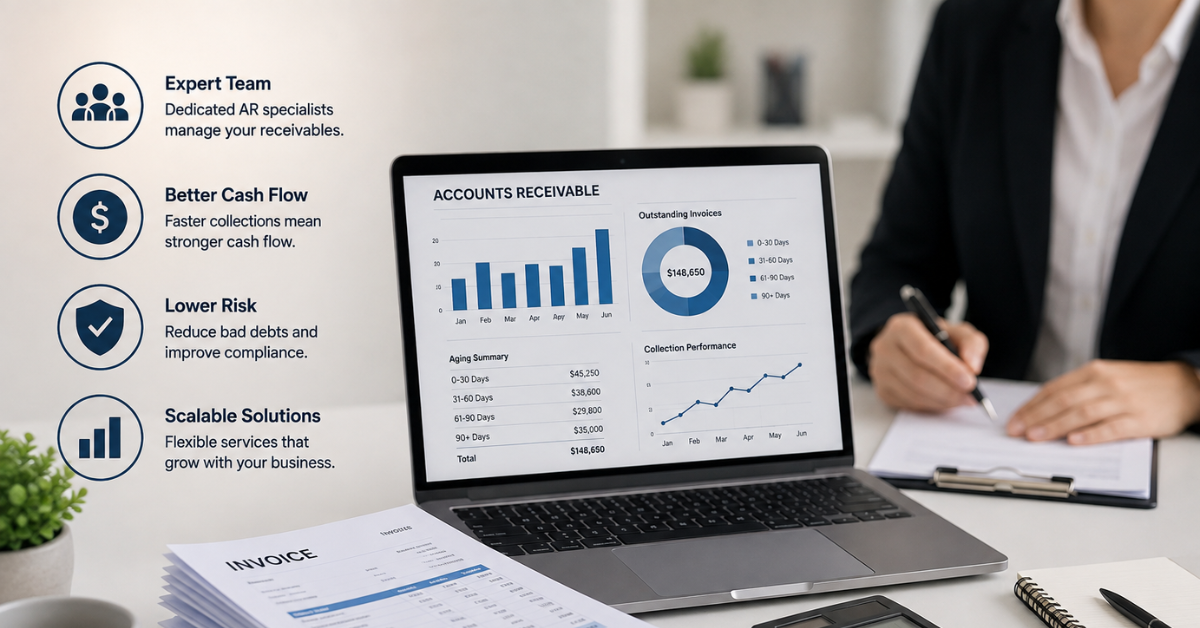
There is nothing more common than cash flow issues because it is not caused by a lack of sales. Far more often, they’re from money which has already been earned but not collected yet. Accounts receivable services are outsourced or software-based solutions that enable businesses to invoice with precision, collect quicker, and save time and stress on chasing outstanding balances.
When your team is buried in spreadsheets, follow-up e-mails, and unpaid invoices, it’s easy to wonder what accounts receivable services really are and when they’re worth hiring them.
What are Accounts Receivable Services?
Accounts receivable services imply the outsourcing, partial or complete of process occupations which are utilized for making collections from the business customers. Instead of performing all tasks needed for invoicing, collections, and reconciliation inside the company, businesses rely upon a provider specialized in the corresponding area for performing this business function in the best way.
What Do These Services Include?
Not all providers offer identical packages, but most accounts receivable services include some combination of the following:
1. Invoice Generation and Delivery
The backbone of healthy cash flow is accurate, timely invoicing. This typically includes automating the process of creating invoices, configuring the appropriate payment terms, and sending each invoice to the right person via the right method, such as email, a portal, or EDI.
2. Processing Payment and Application
When payments are received, they must be matched to the corresponding invoices. Providers ensure the correct application of payments, detect any discrepancies, and do away with the time-consuming manual recon work that can tie up finance teams.
3. Collections and Follow-Up
This is one of the most valuable parts of accounts receivable services. Providers manage reminder schedules, escalation workflows, and direct outreach to customers with overdue balances, all while maintaining a professional tone that protects the customer relationship.
4. Credit Risk Assessment
Numerous AR solutions also assess customers, new or old, to determine creditworthiness and ensure that businesses aren’t extending credit to high-risk accounts.
5. Reporting and Analytics
Common outputs include aging reports, days sales outstanding (DSO) monitoring, and cash flow forecasting. This transparency supports better leadership decision-making instead of reacting to cash shortfalls after they occur.
6. Dispute Resolution
If a dispute arises with a customer, the accounts receivable services team is typically involved in investigating and resolving a dispute, avoiding a situation where a dispute delays payment.
When to use Accounts Receivable Services?
Not every company requires outsourcing from the get-go. Here are the times when businesses tend to see the most benefit from bringing in accounts receivable services:
- Your DSO has been rising. Accounts receivable services can speed up the payment process and help close that gap when it takes longer and longer to receive payment.
- You have a lot of players in the game. If your finance team is spending more time on chasing receivables instead of strategic tasks, outsourcing can save them some time.
- You’re scaling quickly. The development of the internal AR capacity may fall behind rapid growth. There is no need to hire and train new staff right away for the accounts receivable services just to scale with the business.
- You don’t have the ability to see what is happening in real time. When you aren’t sure which invoices are past due or how much cash to anticipate next month then professional accounts receivable services can provide the reporting framework to resolve the problem.
- The rate of bad debt is rising. An increase in write-offs may indicate poor credit approval or lax collections, which are both directly addressed by accounts receivable services.
The Bottom Line
Accounts receivable services aren’t just about collecting overdue invoices. They’re about building a more consistent, streamlined, and professional revenue cycle. Whether it’s a small business trying to stabilize cash flow or a growing company that’s outgrown manual processes, the right support, whether provided by a partner like Kollecta or handled internally, can turn this burden into a revenue-protecting asset.
Frequently Asked Questions
Accounts receivable services typically include invoicing, payment processing, collections, credit risk assessment, reporting, and dispute resolution. The exact scope varies by provider, so it's worth confirming what's included before signing on.
By speeding up invoicing, automating follow-ups, and reducing errors in payment application, accounts receivable services shorten the time between a sale and actual cash in the bank, directly improving liquidity.
No. Small and mid-sized businesses often benefit the most, since they typically lack dedicated AR staff. Many providers, including Kollecta, offer scalable plans suited to businesses of any size.
Pricing varies based on invoice volume, complexity, and the scope of services. Some providers charge a flat monthly fee, while others charge a percentage of collected receivables or a per-invoice rate.