Most guides on debt collection outsourcing frame it as a binary choice: keep collections in-house, or outsource them entirely. In practice, that’s rarely how it actually plays out. Most businesses that handle receivables well run a hybrid model. An internal team handles early-stage reminders and relationship-sensitive accounts, while a third-party agency takes over once an account crosses a specific threshold.
The real strategic question isn’t “in-house or outsourced.” It’s where you draw that line, and getting that threshold right matters more than which side of the binary you land on.
Why This Isn’t Really a Binary Decision
Full in-house debt collection means your team handles everything, reminders, negotiation, and escalation, and the process stays entirely under your direct control. Full outsourcing means handing the entire process to an outside partner from the first missed payment onward. Almost no business actually operates at either extreme. Instead:
- Internal teams handle invoicing, early reminders, and disputes that are really billing questions in disguise, things that resolve fastest with someone who already knows the customer and the account history.
- External partners take over once an account crosses an agreed threshold, typically a specific number of days overdue, or once it’s clear the situation needs more structured, persistent follow-up than an internal team can sustain.
Understanding this changes the question you should actually be asking. It’s less “should I outsource” and more “at what point does keeping this account internal stop making sense.”
A Practical Self-Assessment
A few signals point toward leaning more heavily on outsourcing, and a few point the other way. Lean toward outsourcing more, and sooner, if:
- Your team is spending meaningful time chasing payments instead of revenue-generating work
- Follow-up on overdue accounts happens inconsistently, some get chased, others fall through the cracks
- You’re collecting consumer debt and don’t have dedicated compliance expertise in-house for FDCPA and Regulation F requirements
- Your overdue account volume is growing faster than your internal capacity to handle it
- Accounts regularly sit past 60 to 90 days before anyone escalates them internally
Lean toward keeping more in-house if:
- Your overdue accounts are low in volume and the relationships are high-value or long-term
- Most nonpayment issues turn out to be billing errors or disputes that need context only your team has
- You have staff with actual bandwidth and some collections experience, not just someone doing it between other tasks
- Preserving a very specific customer relationship tone matters more than recovery speed
Most businesses will see signals pointing in both directions, which is exactly why a hybrid model, not a hard either/or decision, tends to be the right answer.
The Real Cost Comparison
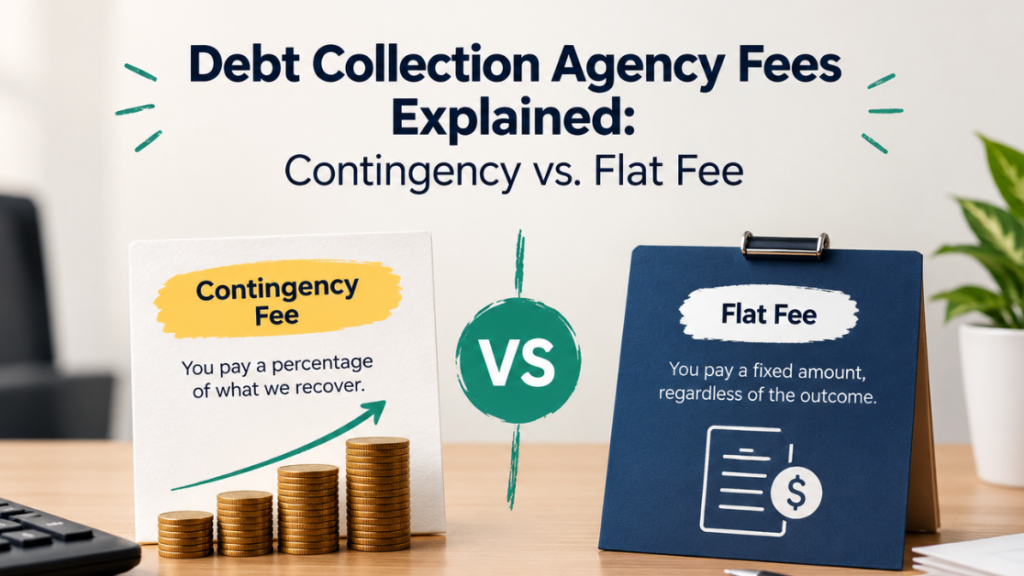
Outsourcing has an obvious, visible cost: the agency’s fee, typically 10% to 50% of what’s recovered, depending on debt type and age. In-house collection has costs too. They’re just less visible.
Staff time is the biggest hidden cost. Every hour spent on collections by an employee is an hour not spent on their actual job, sales, service, growth work. For a small team, this adds up faster than most businesses realize.
Compliance risk is a real, if invisible, cost. For consumer debt specifically, FDCPA and Regulation F violations carry real financial exposure. An internal team without dedicated compliance training is more exposed to this risk than a specialized agency built around it.
Inconsistency has a cost too. Internal collection efforts, run by people juggling other responsibilities, tend to be less consistent than a dedicated agency’s structured process. Inconsistent follow-up is part of why recovery rates on internally managed aging accounts tend to lag behind professionally managed ones.
None of this means outsourcing is automatically cheaper. A percentage fee on recovered funds is a real cost too. It means the comparison isn’t “free in-house” versus “costly outsourced.” It’s two different cost structures, one visible and percentage-based, one less visible and built from staff time, risk, and inconsistency.
What a Hybrid Model Actually Looks Like
In practice, a workable hybrid setup often looks something like this:
- Days 0-30: Handled internally, automated reminders and light-touch follow-up.
- Days 30-60: Still internal, but with direct calls, documented communication, and a formal demand letter if needed.
- Days 60-90: Evaluation point, is the account responsive? Is it a payment plan in motion? Or is it time to place it externally?
- Day 90+: Placed with an outside agency for active recovery, since this is the point where most guidance agrees outside help meaningfully improves outcomes.
This isn’t the only way to structure it, some businesses set the handover earlier for consumer debt, later for large, relationship-important commercial accounts, but it illustrates the underlying logic: internal ownership while resolution is likely cheap and fast, external ownership once it isn’t.
When Full Outsourcing Makes More Sense
A hybrid model isn’t always right. Full outsourcing tends to make more sense when:
- Your business has high account volume and limited internal capacity to manage any of it well
- You’re dealing primarily with consumer debt and want compliance handled by specialists from day one
- Your team has no real collections experience and building that expertise internally isn’t a priority
When Keeping More In-House Makes Sense
Conversely, leaning more internal tends to make sense when:
- You have a small number of high-value, relationship-critical accounts where context and tone matter enormously
- Your team already has real collections bandwidth and a track record of resolving accounts before they age significantly
- Most of your nonpayment issues turn out to be resolvable billing questions rather than genuine unwillingness to pay
Frequently Asked Questions
Not necessarily. In-house collection avoids a percentage fee, but it carries real costs in staff time, compliance risk, and inconsistent follow-up, costs that are harder to see but not necessarily smaller.
Most guidance points to around 90 days past due, once internal reminders and a formal demand letter haven't resolved the account, though some businesses set this threshold earlier for consumer debt or accounts showing clear nonpayment signals.
Yes, this is actually the most common real-world setup. Many businesses keep early-stage reminders internal and outsource only aged or unresponsive accounts, rather than choosing one model for everything.
Not inherently. A reputable agency handles outreach professionally, and for accounts that have already gone unresponsive to internal efforts, the relationship risk from continued internal chasing can be just as real as the risk from outsourcing.
Signs it isn't include inconsistent follow-up, accounts regularly aging past 60 to 90 days before anyone escalates, and no dedicated compliance process for consumer debt rules.
Final Thoughts
The choice isn’t really in-house versus outsourced. It’s figuring out where your business’s specific handover point should sit, and being honest about whether your internal process is actually consistent enough to make that threshold meaningful. Most businesses land somewhere in the middle, and getting that balance right matters more than picking a side.
Kollecta works with businesses at whatever stage they’re ready to hand off accounts, whether that’s early-stage placement or aged receivables your internal team has already worked. If you’re trying to figure out where that line should sit for your business, Kollecta’s team can help you think it through.