Unpaid invoices do not write themselves off. They sit on your accounts receivable aging report, getting older and harder to collect with every passing week. Studies show that 55% of all B2B invoices in the US are overdue at any given time, which means every business extending credit is running some level of recovery risk right now. The good news is that most overdue accounts are recoverable, provided you follow a structured business debt recovery process before the debt ages past the point of no return.
Business debt recovery is the process a company follows to collect money owed by another business or individual for goods and services already delivered. For small businesses, effective recovery means acting early, communicating professionally at each stage, and knowing exactly when to hand the account to a specialist. The longer an invoice sits unpaid, the lower the statistical chance of full recovery.
Why Acting Early Is the Difference Between Recovering and Writing Off
Most businesses treat overdue invoices reactively. An invoice goes 30 days past due, nothing happens. At 60 days, someone sends a reminder email. By 90 days, the account has been mentally written off before any real effort has been made. That pattern is expensive.
The recovery rate on invoices drops sharply after 90 days of non-payment. Accounts under 60 days old recover at significantly higher rates than those past 90 days. Acting early is not aggressive, it is efficient. The seven steps below follow a proven commercial debt collection escalation sequence. Work through them in order, and keep moving.
Business Debt Recovery: 7 Steps to Follow Before Writing Off the Invoice
Step 1: Verify the Invoice Before You Chase
Before any outreach, confirm the invoice is clean. A disputed invoice gives the debtor a legitimate reason to delay payment, and chasing a flawed invoice damages your credibility. Run through these checks:
- Invoice number, amount, and due date are correct
- Delivery or service completion is documented
- The invoice was sent to the right contact and email address
- No outstanding disputes or revision requests are sitting unread in your inbox
Fixing an invoice error after the debtor has raised it delays recovery by weeks. Two minutes of verification before you begin saves far more time on the back end.
Step 2: Send a Structured Reminder Sequence
A single reminder email rarely produces payment. What works is a structured sequence with escalating urgency and consistent follow-through. For how to collect past due invoices effectively, the sequence should follow this pattern:
- Day 1 past due: Friendly email assuming oversight. Include the invoice, amount owed, and payment link.
- Day 7: Follow-up email referencing the first. Firmer tone, same clear ask.
- Day 14: Final written reminder before phone contact. State clearly that non-response will trigger escalation.
Keep every communication professional. The relationship may be worth preserving. A debtor who feels pressured but respected is far more likely to engage than one who feels attacked.
Step 3: Pick Up the Phone
Email is easy to ignore. A direct phone call is harder to avoid and often resolves in a single conversation what three emails could not. When you call, have the invoice details ready, stay calm, and ask one clear question: when will this be paid?
If the debtor raises a dispute or claims the invoice was never received, treat it as information to act on, not a brush-off. Confirm the situation in writing immediately after the call. If they commit to a payment date, document it and follow up the day before.
Step 4: Offer a Payment Plan
Some debtors are not refusing to pay. They are unable to pay in full right now. A structured payment plan recovers partial amounts on a defined schedule, which is almost always better than a full write-off. Partial payment also restarts the relationship and reduces the debtor’s motivation to avoid contact.
Set clear terms in writing: total amount owed, agreed installment amounts, payment dates, and what happens if a payment is missed. Building a collection strategy around flexible payment options often recovers accounts that escalation would otherwise lose entirely.
Step 5: Issue a Formal Demand Letter
A formal demand letter is not the same as a reminder email. It is a written notice stating the total amount owed, the timeline for payment, and the consequences of continued non-payment. Sent at 30 to 45 days past due, it signals that the process is moving toward professional intervention.
The letter should be concise and factual. State the invoice number, amount, original due date, and that failure to respond within a specified period (typically 14 days) will result in escalation. Keep a copy. This document becomes important if legal or third-party action follows.
Kollecta handles steps 5 through 7 as a single integrated process, covering demand letters, skip tracing, and full third-party recovery, all on contingency. No fee unless Kollecta recovers. Talk to the team about your outstanding accounts, no commitment required.
Step 6: Run Skip Tracing If the Debtor Has Gone Silent
A debtor who stops responding is not necessarily gone. Contact information changes. Businesses move. Decision-makers leave. Skip tracing is the process of locating updated contact details for debtors who have become unreachable through normal channels.
For B2B accounts, skip tracing involves searching business registries, updated company addresses, new phone numbers, and current decision-maker contacts. This step is worth taking before assuming an account is unrecoverable. Many invoices written off as bad debt are written off too early, before the debtor has actually been properly located and contacted.
Step 7: Escalate to a B2B Collection Agency
Internal recovery has limits. If an account has been through steps 1 to 6 without resolution, the most effective next step is placing it with a specialist B2B collection agency. This is not an admission of failure. It is the logical escalation in a commercial debt recovery process.
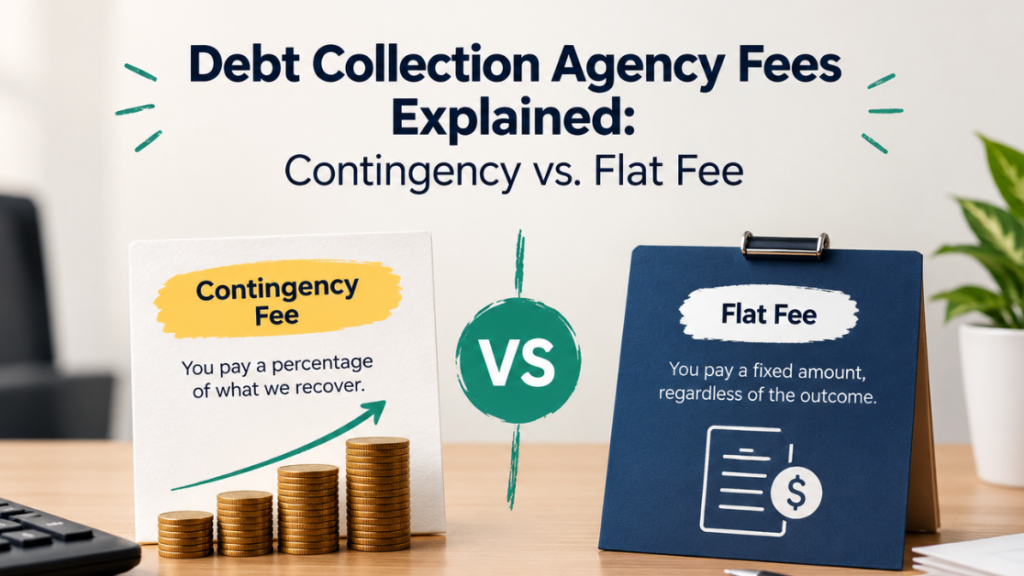
A specialist agency brings three things your internal team typically cannot: dedicated outreach capacity, compliance infrastructure, and negotiation experience with commercial debtors. The right agency operates on a contingency fee model, meaning you pay only when they recover. That aligns their incentive directly with yours. If you are weighing providers, how to hire a collection agency covers what to check before signing, and how much collection agencies charge sets expectations on cost.
Kollecta is built for exactly this escalation point. As a B2B-only agency, Kollecta applies intelligent account analysis to determine the right outreach channel and timing for each debtor, then deploys trained collectors who resolve accounts with professionalism. The result is faster recoveries and preserved client relationships, the two things most at risk by the time an account reaches step 7.
How Long Should Each Step Take?
Speed is critical in business debt recovery. The longer you stay at any one step without resolution, the lower your eventual recovery rate. A reasonable timeline for the full sequence:
- Steps 1 to 3 (verify, remind, call): Days 1 to 21 past due
- Step 4 (payment plan offer): Days 14 to 30
- Step 5 (formal demand letter): Days 30 to 45
- Step 6 (skip tracing): Days 45 to 60 if debtor is unresponsive
- Step 7 (third-party escalation): Day 60 and beyond
Accounts placed with a collection agency at 60 to 90 days recover at meaningfully higher rates than those placed at 120 days or later. The commercial debt collection benchmarks are clear: earlier placement produces better outcomes.
The Difference Between Recovery and Write-Off Is the Process
Business debt recovery is not about being aggressive. It is about being structured, consistent, and willing to escalate at the right time. Most invoices that become bad debt do so not because the money was unrecoverable, but because the follow-up stopped too early or moved too slowly.
Work through each step in sequence. Document every communication. Move to the next step within the timeline. And when internal effort has reached its limit, place the account with a specialist who does this every day.
Kollecta works on contingency across all seven steps, from demand letters and skip tracing through full third-party B2B recovery. Submit your outstanding accounts and get started today. No upfront fee, no recovery means no charge.
Frequently Asked Questions
Business debt recovery is the structured process of collecting outstanding payments owed to a company by another business or individual for goods and services already delivered. It typically progresses through internal reminders, formal demand letters, and third-party escalation if internal efforts fail. Acting early in the process significantly improves the likelihood of full recovery.
The timeline for business debt recovery depends on the account age, debtor responsiveness, and the steps taken. Most straightforward commercial accounts resolve within 30 to 60 days when a structured escalation process is followed promptly. Accounts placed with a specialist B2B collection agency at 60 to 90 days past due recover at higher rates than those escalated later.
A small business should escalate to a collection agency when internal follow-up has run through reminders, phone contact, and a formal demand letter without producing payment, typically at 60 to 90 days past due. Earlier placement generally produces better recovery outcomes. If the debtor has also gone silent and skip tracing has not produced a response, third-party escalation is the logical next step.
Business debt recovery involves collecting money owed between two businesses, which is governed primarily by contract law and has fewer regulatory restrictions than consumer collection. Consumer debt collection is governed by the Fair Debt Collection Practices Act (FDCPA) and additional state regulations protecting individual debtors. B2B recovery specialists like Kollecta focus exclusively on commercial accounts where the rules, tactics, and relationship considerations differ significantly from consumer collection.
Skip tracing in debt recovery is the process of locating updated contact information for a debtor who has become unreachable through normal channels. For B2B accounts, this typically involves searching business registries, company databases, and professional contact records to find current phone numbers, addresses, and decision-maker details. It is a standard step in commercial debt recovery before an account is written off as uncontactable.